
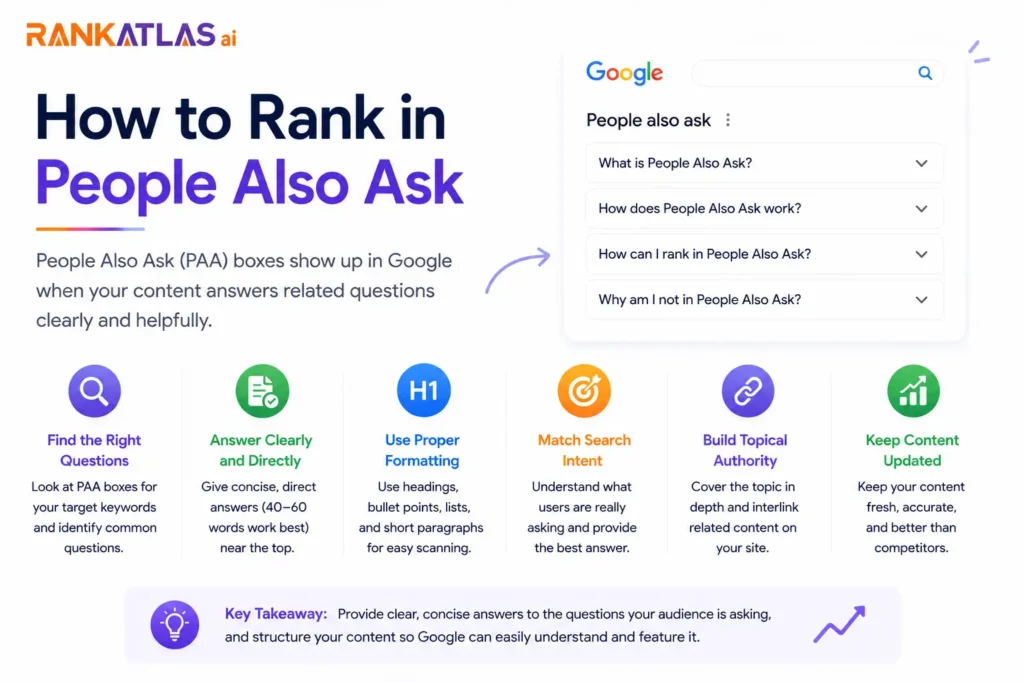
People Also Ask boxes appear in Google search results as expandable questions related to the main query. Getting your content featured in PAA gives you additional visibility on the same page, often above or alongside the main organic results.
Here is what actually works in 2026.
Structure Your Content Around Specific Questions
PAA pulls answers from pages that answer a specific question directly and concisely. The best performing format is a clear question as a heading followed immediately by a two to four sentence answer beneath it. Google extracts that question and answer pair and surfaces it in the PAA box.
If your content buries answers inside long paragraphs with no clear question structure, it will rarely get featured regardless of how authoritative your site is.
Match the Exact Language People Use
PAA questions are pulled directly from how real users phrase their searches. Use tools like Ahrefs, Semrush, or even Google’s own autocomplete to find the exact question format people are asking. Then use that phrasing as close to verbatim as possible in your heading.
A heading that says “How Long Does SEO Take to Show Results” will outperform “Timeline for SEO Results” even if the content beneath both is identical.
Keep Your Answers Short and Direct
78.4 percent of citations that contain questions come from headings. Your H2 tag is the user query. The paragraph immediately beneath it is the answer. Redot Global
Two to four sentences is the sweet spot for PAA answers. Long enough to be complete, short enough for Google to extract cleanly. After the short answer, you can expand with more detail for readers who want to go deeper, but the extractable answer needs to come first.
Use FAQ Schema Markup
Adding FAQ schema to your pages tells Google explicitly that your content is structured as questions and answers. This makes it significantly easier for Google’s systems to identify and extract your content for PAA boxes. It is one of the highest return technical SEO implementations for PAA visibility.
Build Topical Authority Around the Topic
Google is more likely to pull PAA answers from sites it already trusts on a given topic. A site that has covered a subject comprehensively across multiple pages is far more likely to get featured than a site with a single relevant article.
This is why topical clusters matter beyond just rankings. They signal to Google that your site is a reliable source worth surfacing across multiple result types, not just the main blue links.
Target Questions With Existing PAA Boxes
Not every search query has a PAA box. Before optimizing for a question, search the keyword yourself and confirm a PAA box actually appears. If it does, look at what Google is currently pulling and how your answer differs or improves on it. That gap is your opportunity.
Keep Your Content Fresh
PAA results change frequently. A page that was featured six months ago can get replaced if newer content answers the question more directly or if your page has not been updated recently. Refreshing your top PAA performing pages with current information and cleaner answer formatting is worth doing at least once or twice a year.