
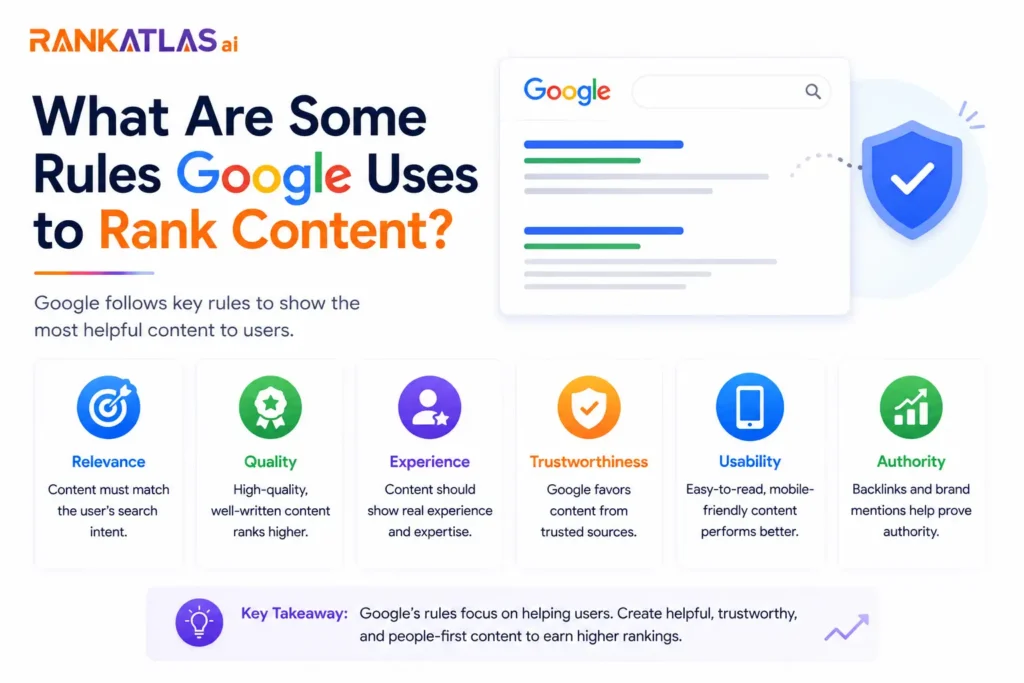
Google has never published a complete list of its ranking rules, and it likely never will. But between its granted patents, official statements from its engineers, and years of algorithm updates, the SEO community has built a reliable picture of what actually determines where your content ranks.
This is not a list of tips. These are documented signals pulled from Google’s own patents and confirmed sources that explain the mechanics behind why some pages rank and others do not, no matter how much work goes into them.
Here is what we know.
1. Information Gain (Google Patent US10776471B2)
This is arguably the most important content signal in 2026. Google’s Information Gain patent rewards content for adding new knowledge not already present in competing pages, not for covering the same ground more thoroughly.
The single biggest shift in the March 2026 core update was the re-weighting of Information Gain. It is no longer one signal among many. It is now the dominant content quality evaluator.
In practical terms, if your article covers the exact same points as the ten pages already ranking for a keyword, Google has a documented mechanism to deprioritize it regardless of how well it is written. Original research, firsthand case studies, proprietary data, and unique expert perspectives are what score high on this signal.
2. Topical Authority and Content Clustering
A Google patent describes grouping websites and pages by topic and creating expert clusters. Content from these clusters is given priority when serving search results for a related query. Content that does not belong to a cluster may be skipped entirely, without any evaluation, regardless of whether it possesses other content quality signals.
This is why a site that covers a topic comprehensively across multiple pages consistently outranks a site with a single strong article on the same subject.
3. Backlinks and Domain Authority
Google’s own senior search quality strategist Andrey Lipattsev confirmed in 2016 that backlinks are a top three ranking factor. Backlinks still matter, but their relative weight has decreased. Quality and relevance of linking domains matter far more than raw count.
4. User Engagement Signals (Google Panda Continuation Patent)
Google’s Panda continuation patent incorporates user click behavior into ranking adjustments. If users frequently click a result and quickly return to the search page, that indicates low satisfaction. Repeat clicks and users spending more time indicate quality. These user behavior patterns modify a site’s quality score.
In short, if people click your result and immediately bounce back to Google, that is a ranking signal working against you.
5. Branded Search as a Popularity Signal
Google filed a patent titled Ranking Search Results that describes using branded search queries as a ranking signal. It is a signal that users themselves are saying a specific website is relevant for specific queries, and it is hard to manipulate, which makes it a clean non-spam signal.
When people search for your brand by name, Google interprets that as a trust signal. This is why brand building and SEO are more connected than most people realize.
6. E-E-A-T (Experience, Expertise, Authoritativeness, Trustworthiness)
While not a single algorithmic signal, E-E-A-T is baked into how Google’s quality raters evaluate pages, which in turn informs how the algorithm is trained and updated. Content written from genuine firsthand experience consistently outperforms content that aggregates what others have already said. Author credentials, external mentions, and site trustworthiness all feed into this evaluation.
7. Helpful Content System (Now Part of Core Algorithm)
The Helpful Content System, which launched in 2022, was folded into the core ranking algorithm in 2024. It no longer operates as a separate system. Its quality evaluation is now embedded across all ranking signals.
This means Google is no longer applying a separate helpful content filter. The evaluation of whether your content is genuinely useful is now happening at every level of ranking assessment.
The Takeaway
Google’s ranking rules are not a checklist. They are an interconnected system that rewards genuine expertise, original contribution, and content that actually serves the person searching. Trying to game individual signals without building real authority rarely works for long.
At Rank Atlas, understanding how Google’s systems actually work is the foundation of everything we do. The most effective SEO is built around what Google’s own patents tell us it values, not tactics that worked three years ago.
Sources:
- https://thestacc.com/blog/google-ranking-factors
- https://www.searchenginejournal.com/googles-branded-search-patent-for-ranking-search-results/524083/
- https://coraseosoftware.net/google-patents-and-seo-2010-2025/
- https://outpaceseo.com/article/what-is-information-gain-in-seo-and-why-ai-engines-demand-it/
- https://www.digitalapplied.com/blog/information-gain-google-ranking-signal-april-2026
- https://www.link-assistant.com/news/google-patents-seo-guide.html
- https://thestacc.com/blog/google-ranking-factors